
A Breakthrough in Pancreatic Cancer Care: How Northwest Cancer Centers Has Prepared for the Era of KRAS-targeted Treatment
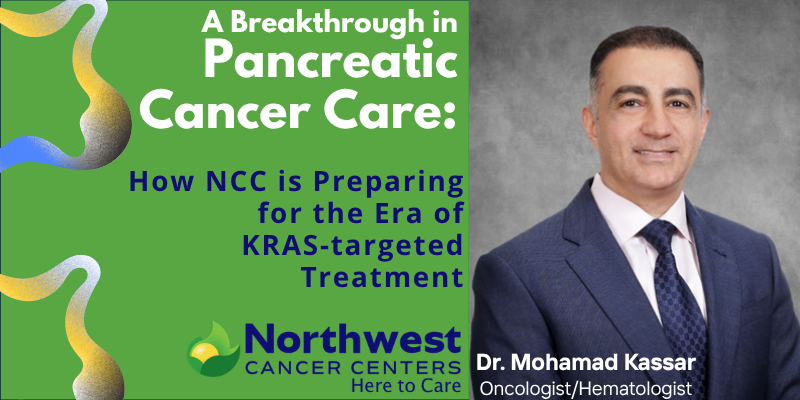
Physicians at Northwest Cancer Centers are now prescribing this breakthrough treatment and arranging for patients to begin treatment.
A Breakthrough in Pancreatic Cancer Care: How Northwest Cancer Centers Is Preparing for the Era of KRAS-targeted Treatment
An estimated 95% of pancreatic ductal adenocarcinomas (PDAC), the most common sub-type of pancreatic cancer, contain KRAS or related RAS mutations. It is these mutations that help drive cancer growth. For years, these mutations were considered nearly impossible to target effectively with medication.¹˒²
Clinical trial results proved that Daraxonrasib will change that! The data surrounding daraxonrasib is so impressive that when it was presented at the ASCO Conference in Chicago in May 2026, it received a standing ovation from the thousands of oncologists and medical professionals present.
For oncologists, preparing for a treatment like daraxonrasib involves far more than simply prescribing a new medication. It requires expertise in molecular testing to identify eligible patients, experience in managing complex oral targeted therapies, coordination with specialty pharmacies, knowledge of patient’s financial assistance resources, and familiarity with a specific pharmacy distribution system and clinical trial pathways.
As the era of KRAS-targeted treatment in pancreatic cancer begins, Northwest Cancer Centers is working to ensure that patients in Northwest Indiana will not have to travel to benefit from the latest advances in cancer care.
Northwest Cancer Centers (NCC) has moved aggressively to prepare for what many experts believe may become the new standard of care for metastatic pancreatic cancer.
Expanded Access Program
Prior to Daraxonrasib’s FDA approval; the treatment was not commercially available. However, some patients were eligible to receive the investigational therapy through an Expanded Access Program (EAP), sometimes called a compassionate use program.3-7
An EAP is a regulatory pathway that allows physicians to request access to certain investigational treatments for patients with serious or life-threatening illnesses when no satisfactory alternative therapies are available and participation in an appropriate clinical trial is not feasible. Access requests must be reviewed and approved by the drug manufacturer, and applicable regulatory and ethics oversight bodies.3-7
This July, following an extensive application process and a physician education program on daraxonrasib, NCC received approval as an EAP location. NCC was the only community oncology practice in Northwest Indiana who actively pursued this pathway for eligible patients.
In addition to the EAP program and a daraxonrasib specific education program, NCC providers have been gaining experience to prepare for this and other similar medications.
Experience With Advanced Targeted Oral Therapies
The rapid emergence of targeted therapies has transformed cancer care. As these treatments have developed, NCC physicians and pharmacists are continuously educating themselves on the specific aspects of each medication to understand when, if, and how a new treatment can be the optimal therapy for each individual patient.
Factors we consider include whether the correct mutation/biomarker is present in order for the treatment to be effective, the individual’s kidney and liver function, interactions with other medications, food administration requirements, preparation of a toxicity monitoring plan, dose modification guidance, and whether a patient has the understanding and adherence readiness to begin treatment.
Over the past 5 years, we have gained extensive experience prescribing and monitoring these complex oral oncology medications across multiple cancer types.
This experience positions NCC providers to quickly integrate daraxonrasib into patient care.
Advanced Molecular Testing Readiness
Many oral targeted therapies only work in tumors with specific molecular alterations (biomarkers), making molecular testing a critical step in selecting appropriate treatment. 8 Because identifying KRAS and other clinically relevant mutations is essential, NCC already works with several leading next-generation sequencing (NGS) platforms and provide molecular testing partners to help determine the genetic profile of a patient's tumor. This expertise allows physicians to rapidly identify patients who may benefit from emerging targeted therapies.
Established Research Referral Relationships
Before the Expanded Access Program became available to NCC patients, our physicians were already working to identify patients who they suspected may benefit from daraxonrasib. As a community oncology practice with an emerging research program, NCC physicians routinely screen their patients for available trials at NCC.
Pharmacists and Physicians Already Preparing
NCC pharmacists and physicians have proactively reviewed the emerging clinical data as well as available NIH and manufacturer educational materials regarding daraxonrasib. Additionally, NCC physicians and the clinical leadership team have met with the Medical Science Liaisons of Revolution Medicine to review data and receive training on the various factors described above that pertain to treating any individual with daraxonrasib. This preparation ensures readiness. The goal of NCC providers is simple: have the knowledge to identify eligible patients quickly and facilitate access as efficiently as possible should approval or expanded access opportunities arise.
Financial Assistance Planning Already Underway
Advanced cancer therapies often bring questions about affordability. NCC's financial counseling team is already preparing for potential patient assistance pathways and has experience connecting patients with national and local support organizations, including:
Patient Access Network (PAN) Foundation
Patient Advocate Foundation (PAF)
Northwest Cancer Centers Foundation
This preparation is intended to help minimize financial barriers for patients who may ultimately qualify for treatment.
Looking Ahead
For years, pancreatic cancer patients have had few treatment advances to celebrate. Daraxonrasib may represent the beginning of a fundamentally new treatment era—one built on precision medicine, molecular testing, and targeted therapies rather than conventional chemotherapy alone. 9,10
While FDA approval was still pending, Northwest Cancer Centers were in action. Through participation in the Expanded Access Program, coordination with leading academic institutions, investment in molecular diagnostics, expertise in oral targeted therapies, and proactive patient-support planning, NCC has positioned itself to help bring this potentially transformative treatment to patients throughout Northwest Indiana as appropriately, efficiently, and quickly as possible.
To Schedule an Appointment or Second Opinion
If you would like to schedule an appointment or second opinion with a specialist at Northwest Cancer Centers to see if Daraxonrasib is the appropriate treatment for you, click on this link, complete the appointment request form, and our patient care coordinators will call you within 24 hours to initiate scheduling. Request a New Appointment
References
1. Helwick C. Daraxonrasib Extends Median Survival in Previously Treated Metastatic Pancreatic Cancer. The ASCO Post. June 10, 2026.
2.Oncology Central. ASCO 2026: Multi-Selective RAS(ON) Inhibitor Yields Unprecedented Survival Gains for Metastatic Pancreatic Cancer. June 1, 2026.
3.Revolution Medicines. Expanded Access Policy. May 2026.
4. Hirshberg Foundation for Pancreatic Cancer Research. FDA Expands Access to Daraxonrasib: What Patients Need to Know. May 20, 2026.
5. ClinicalTrials.gov. Expanded Access Program for Daraxonrasib (RMC-6236) in Previously Treated Metastatic Pancreatic Adenocarcinoma (NCT07573215). Updated May 2026.
6. U.S. Food and Drug Administration. FDA Permits Expanded Access for Investigational Pancreatic Cancer Drug. May 1, 2026.
7. Revolution Medicines. Statement on FDA Expanded Access Authorization for Daraxonrasib in Patients With Previously Treated Metastatic Pancreatic Cancer. May 1, 2026.
8. National Cancer Institute. Targeted Cancer Therapies. National Cancer Institute. Updated August 17, 2023. https://www.cancer.gov/about-cancer/treatment/types/targeted-therapies
9. Pancreatic Cancer Action Network. KRAS in Pancreatic Cancer. PanCAN. https://pancan.org/facing-pancreatic-cancer/patient-services/research-and-clinical-trials/kras/
10. Harvard Medical School. The long-sought promise of targeting KRAS in cancer. Harvard Medicine Magazine. Published 2024. https://hms.harvard.edu/news/experimental-drug-doubles-median-survival-patients-metastatic-pancreatic-cancer