
Cancer Clinical Trials: What Every Patient Should Know
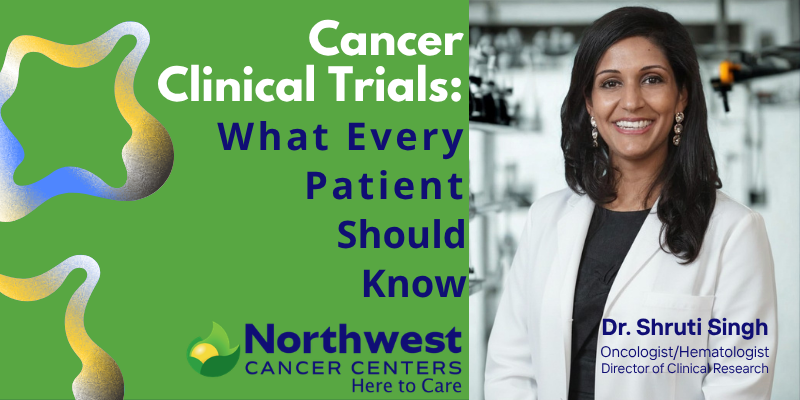
Our physicians participate in national research studies evaluating new cancer treatments and work with patients to determine when a clinical trial may be an appropriate treatment option.
Like in many other aspects of life, technology has accelerated the pace of innovation in cancer care. Specifically, during the past two decades, breakthroughs like immunotherapy, advancements in molecular genetic testing, and targeted precision medicine have transformed how we detect, treat, and even prevent many cancers. Simultaneously, as treatments have advanced, data analysis has shown an increased rate of patient participation in clinical trials (1)
In my role as the Director of Clinical Research at Northwest Cancer Centers, I work as a research scientist, identifying trials for our research program to participate in. It is important for us to identify potential therapies that will not only help advance cancer treatments but will offer options for our patients that are not available elsewhere in the region.
In my role as a medical oncologist, I spend each week working closely with individual patients. In collaboration with their other healthcare providers, we identify the most appropriate treatment based on their specific cancer type, the molecular profile of their tumor, DNA & genomic testing results, and their individual treatment goals. For most patients, this means a plan of care centered around the latest FDA approved treatment recommended by the National Comprehensive Cancer Network (NCCN) Clinical Practice Guidelines.
An equally important part of developing an individualized treatment plan is determining whether participation in a clinical trial may be appropriate and of interest to the patient. This includes screening for trials available at Northwest Cancer Centers, as well as evaluating known opportunities at other institutions when suitable.
During this evaluation, it is our responsibility to determine whether the patient understands what a clinical trial is, confirm that they understand the advantages and risks of participation, and most importantly confirm that trial participation is the right choice for them.
Understanding the following questions and answers may help you or a loved one determine whether participation in a clinical trial is right for you.
What Is a Clinical Trial?
What Are the Different Phases of Clinical Trials & What Does Each Phase Study?
Who Should Consider Participating in a Clinical Trial?
What Are the Benefits to the Patient of Participating in a Clinical Trial?
What is a Clinical Trial?
Clinical trials are research studies that are used to evaluate new treatments. These trials may study new drugs, surgical procedures, or testing methods, to determine first their safety, then their effectiveness.
Before a new product or treatment is approved for use by the FDA, it must go through 4 phases of development. Each phase represents a significant milestone in the development of an advancement in treatment. There are also trials conducted after a treatment has been approved by the FDA.
What are the Different Phases of Clinical Trials?
Preclinical Phase: The first phase of development is the “Preclinical Phase”. This phase does not involve human subjects. This is where a new drug is studied in the lab on cell tissue or animals to gather some information on potential dosing and toxicity to determine if there would be a benefit to test the drug on humans. This phase most often lasts several years.
Phase 1: Once the Preclinical Phase is completed, the next step is a Phase 1 trial. A Phase 1 Trial is the first time a particular medication, procedure or device is used on live humans. The primary goals of a Phase 1 trial are to evaluate safety and to gather information on how the drug interacts within the human body. This may include identifying side effects, safe doses, and potentially effective doses. Phase 1 trials typically last several months and may only include 10-50 patients. These patients come from a broad range of cancer types (2). After the Phase 1 trials are complete, nearly 70% of all Potential treatments show safe dosing options and a reason to move on to Phase 2.
Phase 2: In Phase 2 trials researchers hope to determine if a potential treatment is effective, learn more about safe dosing, & side effects. These studies typically only study patients with 1 or 2 specific cancer types. They may have several dozen patients or maybe several hundred. Usually in Phase 2 clinical trials, all patients receive the same dose. Sometimes, patients are placed randomly in different treatment groups. In these cases, each group may get different doses or get the treatment in different ways to see which provides the best balance of safety and response. These trials usually last several months but may last up to 2 years. If enough participants in the Phase 2 trials appear to benefit from the treatment, and the side effects don’t outweigh the potential benefits, Phase 3 clinical trials can begin. Only about 20% of treatments that begin in Phase 1 trials make it to this point (2).
Phase 3: Phase 3 clinical trials compare the safety and effectiveness of the new treatment against the current standard treatment to determine if it is a better treatment option than is currently available.
These studies most often have thousands of patients participating at dozens of different research institutions, hospitals, and community offices across the country. Phase 3 trials last for several years so enough data can be collected to determine if the new treatment being studied is in fact better than the standard of care already FDA approved and recommended.
Often these trials have multiple arms. Some patients in these trials will be randomly chosen to receive the current standard of care. Others will receive the standard of care plus the new medication that is being tested. A third arm may test the standard of care plus a placebo. This helps the researchers determine if the tested drug benefits the patients while still providing them with at least the same treatment they would receive had they not participated in the trial.
Regardless of the type of Phase 3 trial, a patient will know exactly what the possible arms of the trial are before electing to participate. They will know whether they are guaranteed to be receiving the current best available therapy or if they may be participating in a trial where they may only be receiving a new therapy which may or may not prove more effective than the standard of care (2).
It is at the conclusion of Phase 3 trials that treatments thought to have a benefit to patients will apply to the FDA for approval.
Phase 4: Once a treatment has been approved by the FDA, there is often much more that may be learned about the new treatment. Phase 4 trials are conducted on treatments that have already received FDA approval and are used as standard of care. These trials can serve one of many purposes. They may monitor patients over many years to help determine long term safety. They may gather information on specific patient populations, such as a specific age group or people with specific underlying medical conditions. Other Phase 4 trials are designed to study the optimal benefit of the treatment with the lowest side effect profile. Another common goal is to identify whether there are additional diagnosis’ where patients may receive a benefit in addition to the indications that were studied prior to the initial FDA approval (3).
Who Should Consider Participating in a Clinical Trial?
Today, clinical trial participation is higher than ever before. However, phase 1-3 trial participation is still only about 7% of all patients undergoing cancer treatment. So how do we determine who should consider participating in a clinical trial?
The answer is not universal but…
… patients who are newly diagnosed and have multiple options available may consider joining a trial. Trials may offer the possibility of accessing cutting-edge treatments that may be more effective than standard therapy. This is particularly true of Phase 3 trials.
… patients with cancer who have exhausted standard treatment options may benefit from a treatment option being investigated in a trials.
… patients for whom standard treatments have not been effective may consider participating in a clinical trial, particularly phase 1, 2 or 3 trials.
… patients who want to help advance cancer care may be able to accomplish this goal by trial participation.
What Are the Benefits to the Patient of Participating in a Clinical Trial?
Access to Potentially Effective Treatments: Clinical trials often offer access to new drugs or treatment approaches that are not yet widely available. By participating, patients may have access to promising treatments they could not otherwise receive. These treatments may potentially improve their outcomes.
Close Monitoring and Care: Clinical trial participants receive close monitoring and care from a team of healthcare professionals who specialize in the specific treatment being studied. This level of attention can be beneficial for patients, as it gives them access to a team of research professionals not available to other patients. This additional layer of support can ensure that any side effects, complications, and other patient needs are more promptly addressed.
Contribution to Medical Knowledge: By participating in a clinical trial, patients contribute to the advancement of medical knowledge. Their involvement helps researchers better understand cancer and develop new treatments that may benefit future patients.
Personal Satisfaction: Many patients find participating in a clinical trial to be personally fulfilling, as it allows them to play an active role in their own treatment and contribute to the greater good by helping to advance medical science.
What Are Other Things To Consider When Evaluating Trial Participation?
It's important to note that while there are potential benefits to participating in a clinical trial, there are also risks and uncertainties involved. These risks include the possibility of experiencing unknown side effects from the experimental treatment or the treatment being less effective than standard therapies. Therefore, it's essential for patients to carefully weigh the potential benefits and risks and discuss their options with their healthcare team before deciding whether to participate in a clinical trial.
In conclusion, clinical trials offer patients with cancer the opportunity to access innovative treatments, contribute to medical knowledge, receive close monitoring and care, and experience personal satisfaction from participating in cutting-edge research. While participation involves risks, it is a decision that should be carefully considered in consultation with healthcare professionals.
Northwest Cancer Centers has the largest community oncology clinical research program in Northwest Indiana. Our physicians participate in national research studies evaluating new cancer treatments and work with patients to determine when a clinical trial may be an appropriate treatment option.
How Can I Find More Information on Trials Currently Available at Northwest Cancer Centers?:
Click on this link to review trials currently available at Northwest Cancer Centers
Sources
1. Journal of Clinical Oncology - Joseph M. Unger, Lawrence N. Shulman, Mark E. Fleury April 2, 2024 National Estimates of the Participation of Patients With Cancer in Clinical Research Studies Based on Commission on Cancer Accreditation Data | Journal of Clinical Oncology
2. Clinical Trial Hub – Admin , March 2026 What Are Clinical Trial Phases? Phase 1 Through Phase 4 Explained | ClinicalTrialHub
3. Plaintrial.com – Editorial Publication, June 25, 2026 Understanding Clinical Trial Phases: From Phase 1 to Phase 4